
Portrait of Ommo Clark
— Ommo Ommo

In 2004, I was managing the mortgage origination platform at Lehman Brothers in London — the e-trading system within the Mortgage Capital Division that captured loan applications and provided acceptances in principle to mortgage brokers. The systems were already pattern-matching and making predictions. We just hadn't started calling it AI yet.

I started my career at Real Asset Management (now called MRI Software) in London, UK, supporting enterprise accounting and project management software — the kind of mission-critical infrastructure that taught me what makes systems trustworthy in the first place. The e-trading platforms, the AML risk-rating systems I worked on later at Lehman Brothers and Kaupthing Singer & Friedlander were doing what AI systems do now: ingesting structured and semi-structured information at scale, producing decisions, surfacing exceptions, and shaping outcomes for people who would never see the code.

That early experience shaped how I think about AI today. For me, it has always been about more than the surface of the technology, and I am not surprised by what it can do. I am interested in the question that has always mattered: will this system help people do what they do more efficiently? Will it contribute to making society better and safer?

The Through-Line

From building systems for banks to building a software firm in Lagos.

I left London in the late 2000s, moving back to Nigeria, where I had spent my early years. At Soft Solutions in Lagos, I delivered enterprise banking systems — treasury, lending, asset management — for Access Bank, Diamond Bank, Skye Bank, FCMB. The same pattern as London, but in a market with different constraints, different talent pipelines, and entirely different assumptions about what infrastructure could be relied on.

In 2013, I founded iBez Consulting. Over the next decade, my team and I took products from concept to deployment for clients across government, education, healthcare, retail, NGOs, and financial services. We built Handy-Jacks, a platform connecting verified tradespeople with home-owners and organizations that needed their services. We also built a blood data system, learning management platforms, an electronic medical record, a fintech platform, and e-commerce websites — and digitized numerous businesses along the way. A lot of it succeeded. Some of it taught me what does not.

The through-line, looking back, is productization. The discipline of turning an idea — a research finding, a market gap, a hunch about how things should work — into a system that survives contact with real users. Most AI work I see now stalls at exactly this step.

The technology gets the attention. The architecture decides what survives.

My twenty years of operating experience are not a detail of my CV. They are the reason I think the way I do about AI strategy. I have made architectural decisions I had to live with for years afterwards. I know what it costs to put a badly designed system in front of users. I know what survives a regulatory audit and what does not. That is the foundation the strategy work rests on.

Ommo Clark in a Lagos office, 2021
— Lagos · 2021. Building systems in markets where reliability is not assumed teaches a discipline that is hard to come by elsewhere.
The Doctorate

Why I went back to school.

Along the way, I had started to notice that we were not using our rich data properly — that there were serious gaps in how we used data to inform the systems we were building. Too many systems were designed without grounding in real-world research, and too many were not meeting real needs. I wanted to do something about that.

I wanted to work on this seriously — not as a consultant with opinions, but as a researcher with a defensible argument. So in 2023, I started a doctorate in Information Systems at the University of Maryland, Baltimore County. My dissertation, From Misinformation Detection to Online Health Safety: Narrative Blindness, Risk Irrelevance, and the Limits of Epistemic Conformity, is where that work lives.

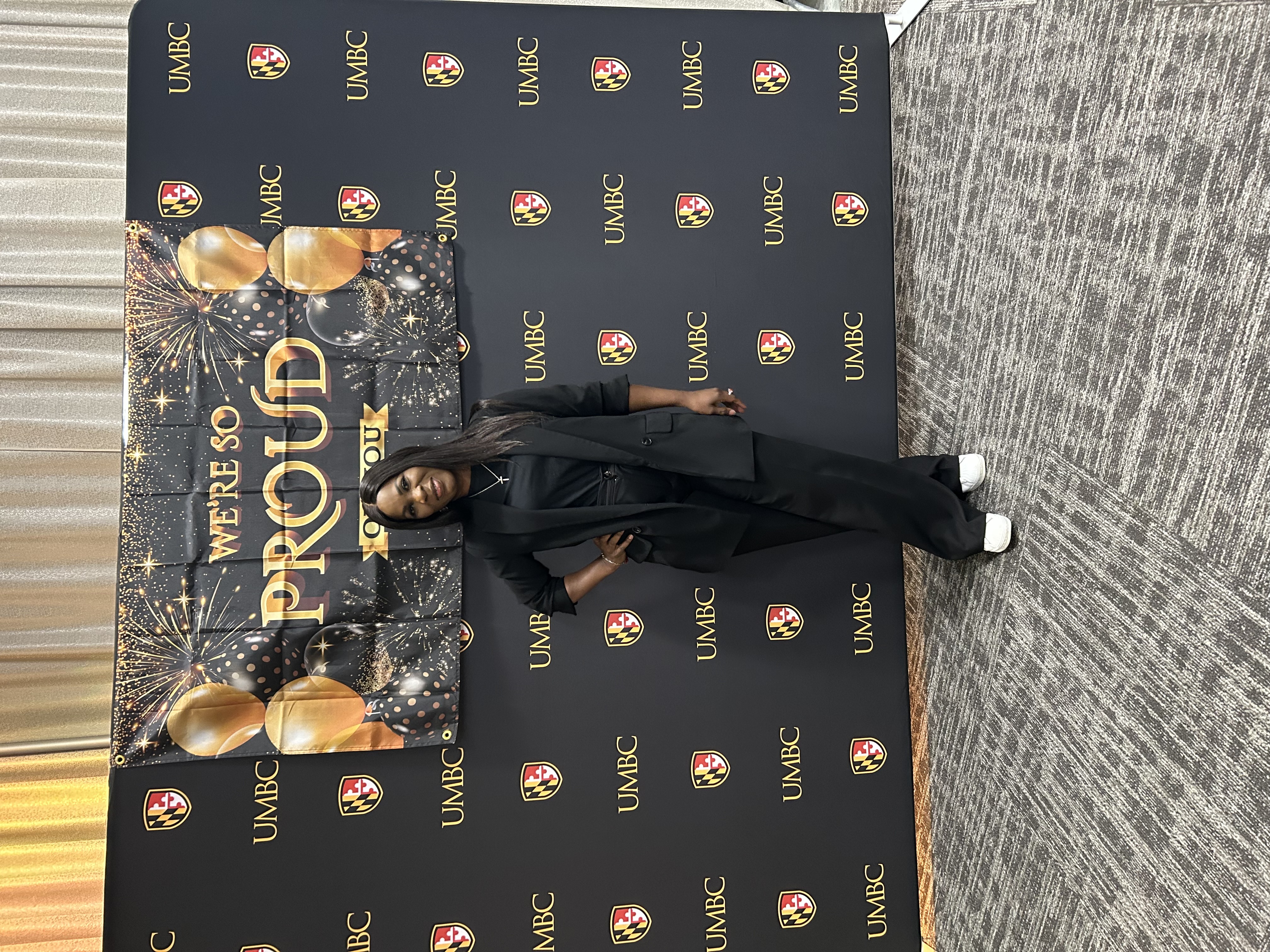
Ommo Clark at UMBC, 2025, in front of a UMBC step-and-repeat
— UMBC · 2025. Going back to school after an established career was a deliberate choice. The questions I wanted to answer required the rigor of formal research.
What I Do Now

Strategist, advisor, researcher, teacher, speaker, occasionally a builder.

I work with leadership teams and founders on the AI questions where being wrong is expensive — health, finance, regulated information, public trust. The work runs through three phases: strategy (deciding what to build and what good looks like before development begins), productization (the discipline of getting from prototype to deployable system), and governance (the technical and policy frameworks that determine how the system is run once it is live).

I also teach. The discipline of productization is not something most founders or executives have access to in any structured form, and I have spent years translating it for non-technical audiences. To date, more than 3,000 founders and executives across the UK, Nigeria, and the US have come through programs I have designed or delivered.

And occasionally I still ship products of my own. The advisory work and the teaching are stronger when they are grounded in the practice of actually building. It is harder to drift into theory when you are still living in the trade-offs.

Where I Stand

The AI safety conversation has been organized around the wrong question. Truth is one axis. Risk is another. Treating them as the same axis is the structural error our current systems are built on, and the cost of that error falls hardest on the people with the least margin for being wrong.

I am a practitioner who has spent two decades building systems for environments where mistakes are expensive, and who has done the research to support a specific structural claim about how the field can do better.

The work I do is for organizations and policymakers who want to move beyond surface-level adoption and engage seriously with the questions that determine whether these systems actually deliver value — and whether they serve the people and communities that need them most. I am passionate about using technology for social good, and I work best with people who care about getting it right.

At a Glance

The verifiable record.

Education

  • Ph.D. Information Systems UMBC · Expected Fall 2026
  • M.Sc. Information Systems Brunel University of London · 2001
  • B.A. (Hons) Business Administration London Metropolitan University · 2000

Recognition

  • Special Recognition Award — Women Driving the Growth of Sustainability, Responsible Innovation & Inclusivity Conference London, UK · October 2024
  • Tropics Magazine — Top 700 Most Influential African #AfricanDoers Powerlist July 2022
  • Best Group and Team Leader — She Works Here Acceleration Program Lagos · July 2020
  • TechCabal — Top 21 Nigerian Women in Tech April 2020
  • Excellence Award — GLFY Benin City · March 2020
  • Merit Award for ICT/Tech — Izon Ladies Association January 2020
  • Nominated for ELOY Award for Women in IT October 2019
  • Nominated for Role Model Award (Honorary Fellow) — Institute of Attitudinal Change Managers August 2019
  • Lionesses of Africa — 21 Female Technology / Digital Gamechangers in Africa 2018
  • Naij.com — 21 Most Inspiring Women Entrepreneurs in Nigeria 2017
  • Global Women Entrepreneur Institute (GWEI) Fellow, Ivan Allen College, Georgia Tech 2015
  • Handy-Jacks — Semi-Finalist, IDB (Islamic Development Bank) Business Plan Competition (633 applicants across Africa) October 2014
Reach Me

If the work I do fits the work you need, let's talk.

Strategy and advisory engagements, AI policy and governance work, executive and founder education in productization, and speaking invitations.

I read everything. I respond personally to the messages that warrant it.